Thursday, February 01, 2007

Another Nomination for Gore

Al Gore was recently nominated for a Nobel Peace Prize by a Norwegian member of Parliament. Boerge Brende, the man who nominated Gore, cited Gore's extensive environmental work, including last year's Oscar-nominated documentary An Inconvenient Truth.

"A prerequisite for winning the Nobel Peace Prize is making a difference, and Al Gore has made a difference," Conservative Member of Parliament Boerge Brende, a former minister of environment and then of trade, told The Associated Press.


Brende said he joined political opponent Heidi Soerensen, of the Socialist Left Party, to nominate Gore as well as Canadian Inuit activist Sheila Watt-Cloutier before the nomination deadline expired Thursday.


"Al Gore, like no other, has put climate change on the agenda. Gore uses his position to get politicians to understand, while Sheila (Watt-Cloutier) works from the ground up," Brende said.


This made me think about efforts being made by some folks on the left side of the aisle to persuade Al Gore to run for President in 2008. A lot of people think that Al Gore is the most qualified person in the country to be the President.

I agree. But I don't think he should run.

Don't get me wrong. If he were the nominee, I'd vote for him, and I'd do it with a smile on my face. I think he was wrongly maligned by his opponents in 2000, I think he was portrayed as stiff when he's really not, and I think that he's a strong, able and intelligent leader.

But Gore's found his niche. He's eloquent, passionate, and most of all effective as an advocate for climate change awareness. I can't help but think that another Presidential campaign, if unsuccessful, would set his work back at a time when it really can't afford to be set back.

Others would counter that if elected, Gore could reach much more with his message. But could he? With the other pressures of the Presidency, could Gore devote as much time to this pressing cause as he can currently? And could he really reach more people as the President than he has as the maker of the third highest-grossing documentary of all time?

I'd love to see a Gore Presidency. More than that, I'd love to have seen a Gore Presidency. I think he'd make a good President. But I think the work he's doing now is more important, and I think he sees that.

Fargus...

Wednesday, January 31, 2007

Stuart Saves the Senate


Nothing formal's been announced yet, but MSNBC's reporting that Al Franken has decided to run for the United States Senate.

A lot of folks over at TPMCafe were debating whether or not this was a good idea, and whether or not Franken actually stands a chance at winning the election. Personally, I really like the guy. I've got one of his books up on the shelf (Lies and the Lying Liars Who Tell Them: A Fair and Balanced Look at the Right), and it was really good. Good enough for there to be several right-wing sites established to try to debunk him.

What's more, I think he stands a real chance at winning the election. He's going to be running in Minnesota, and he's actually from Minnesota originally and lives there currently. He was very close friends with the immensely popular Paul Wellstone, who died in a plane crash in 2002 during his Senate re-election campaign. He's consistently been an articulate and passionate progressive voice, especially since Bush's election in 2000.

So, in conclusion, in Minnesota's 2008 U.S. Senate race, I'm throwing the full endorsement of The Fargus Report behind Al Franken.

Fargus...

Hillary, Be Not Proud

Through Decision '08, the only conservative blog I can bring myself to read anymore, I found this incomprehensible criticism of some statements that Hillary Clinton recently made (I apologize for the length of the excerpt, but there's really not that much content to cut. Just tough it out):

In essence, Senator Clinton declared: The war in Iraq is Bush's mess, and it is his job to clean it up before I become President and have to do it myself.


More precisely, Senator Clinton argued that it was Bush's "decision to go to war with an ill-conceived plan and an incompetently executed strategy." That is, the Iraq war is Bush's mess. "We expect him to extricate our country from this before he leaves office." That is, we expect him to clean up his mess. Bush has said that this cleaning up the Iraq mess was "going to be left to his successor," namely, Senator Clinton herself, a prospect which explains the Senator's final outburst, "I think it is the height of irresponsibility and I really resent it." (Italics mine.)


And why shouldn't she resent it? Would you like to wake up one day, find that you are the President and that it is up to you to bring stability and order out of the chaos and bloodshed in Iraq?


The moral punch of the Senator's underlying analogy is obvious. We can all grasp it just as readily as Lincoln's compatriots could grasp his conceit about swapping horses in the middle of a stream. If someone else has made a mess, it's his job to clean it up—not yours or mine. For example, if mom comes home one day and finds that her sons have been playing paintball in the dinning room, it's their duty to clean up the mess they've made—not mom's. Nor could we blame mom for being resentful if, despite the obvious right and wrong of the situation, she ended up, as she often does, with the task of removing the splattered paint all by herself. Indeed, it is possible that Senator Clinton's analogy will have an especially potent appeal to women voters, since women have traditionally been assigned the thankless task of cleaning up the mess their men folk and boy folk leave in their wake. What woman can't say, "Been there, done that?"


There is, however, a problem with Senator Clinton's analogy—a problem so serious that it forces us to wonder if she genuinely understands the nature of the office that she is currently seeking, and to see what I mean let us go back to the case of Mr. Lincoln.


When Abraham Lincoln was sworn in as President, he inherited a mess in comparison with which Iraq pales to insignificance. The states in the Deep South had already left the Union. The previous President, James Buchanan, had not lifted a finger to keep the vast majority of Federal forts and arsenals from falling into the hands of the new Confederacy. Buchanan's position was that the Constitution did not allow for states to secede, but at the same time, neither did it allow the Federal government to use coercion to keep them in the Union against their will. So what to do, except to do nothing?


The biggest mess of all, however, arose from the fact that the newly inaugurated President's government was still in control of two remaining military outposts in the Confederate States, Fort Moultrie in Florida and Fort Sumter in South Carolina. Had Buchanan given the order to evacuate both forts while he was still President, then Lincoln would not have been faced with the dreadful decision of whether to abandon them or to re-supply them when it was his turn to be President. By abandoning these forts, Lincoln knew he might avoid a civil war; by re-supplying them, he knew he would almost certainly begin one. Yet by abandoning the forts, Lincoln also knew that he would be abandoning the Union. Thus the choice that confronted Lincoln on obtaining the office of Presidency was the hideous alternative of disunion or civil war—in short, the mother of all messes.


Historians have, by and large, been exceedingly harsh on Buchanan. He should have done something decisive, the way Lincoln did. Yet Buchanan himself had no more choices than Lincoln did. Yes, Buchanan in theory could have acted decisively: he might have decisively let "the erring sisters" go in peace, or else he could have decisively started the blood bath that became known as the American Civil War. But in either case, Lincoln would have inherited the horrific consequences of Buchanan's very decisiveness—a raging civil war already in progress or a Confederacy of Southern States whose legitimacy had already been recognized by the North. In other words, no matter what Buchanan did or didn't do, Lincoln was bound to become President with an enormous mess on his hands. But that, we must remind ourselves—and Senator Clinton--is the nature of the American Presidency. If you become President, the chances are very good that you will have to start by taking responsibility for someone else's mess.


There are myriad reasons to dismiss comparisons of the current conflict in Iraq to the American Civil War, but only one really matters in this case: the complete disparity between the events leading up to the American Civil War and the events leading up to the current conflict in Iraq.

The author refers, near the end of the piece, to the fact that it was inevitable that Lincoln would have to clean up some mess, because no options that Buchanan had before him would have made for a tidy resolution of the conflict before Lincoln took office. Fair enough. I don't know enough about Civil War history to make a pronouncement on this, but I have no problem accepting it as given. It fits well enough into whatever historical narrative I have been taught over the years.

The problem, though, is that for the analogy to hold, all of the events that precipitated the mess that Buchanan handed to Lincoln would have to have been Buchanan's fault directly. The current conflict in Iraq is and always has been George W. Bush's conflict in Iraq. After 9/11, he pushed the war with Iraq. He shifted the focus from Afghanistan, and the people who actually attacked us. He's owned this "war" from the get-go.

In contrast, any student who wasn't asleep during U.S. History in high school could tell you that the events that precipitated the American Civil War had been brewing for over 50 years. Indeed, upon passage of the Missouri Compromise, Thomas Jefferson penned the following lines to John Holmes*:

"...this momentous question, like a fire bell in the night, awakened and filled me with terror. I considered it at once as the knell of the Union. It is hushed, indeed, for the moment. But this is a reprieve only, not a final sentence. A geographical line, coinciding with a marked principle, moral and political, once conceived and held up to the angry passions of men, will never be obliterated; and every new irritation will mark it deeper and deeper."

You may notice that I bolded all of the references to "Senator Clinton's analogy" in the article above. That was just to point out the fact that Senator Clinton made no analogy. The author of the article did, and it's a pretty easy one to dismiss as fatuous. But Senator Clinton made a statement about resenting the fact that George Bush got our country into the mess it's in now in the Middle East. No analogy there.

Fargus...

*Maybe it's indicative of the fact that I'm depraved, but when I saw the name "John Holmes," my immediate thought wasn't of a 19th century politician.

DiggIt!

Epic Movie

Last night I got home from work around 5:00, and my roommate Jason told me that he and Darren were going to the movies at 5:40, and that I was welcome to go along.

"What are you going to see?" I asked.

"Epic Movie," he said. I groaned. "Well, you don't have to go if you don't want to," he said.

"No, I don't have anything better to do. I'll go. I'll just bring a book along."

At this point I should explain to my reader(s) that we have a deal through our cable company that allows us to get two free movie tickets at the local theater every Tuesday. So does Darren. The only reasons I would consider going to so transparent a piece of crap are because it was free, and I didn't want to sit holed up in my room all night.

"Jason, isn't there anything else playing?" I asked.

"Smoking Aces," he replied. "But we're probably going to save that for next week."

"Why?" I pleaded. "For the love of God, why?"

"Well, from the reviews, Epic Movie is bad enough that it probably won't be in the theater by Free Movie Tuesday next week, but Smoking Aces will probably still be there by then."

I shit you not.

Jason's reason for wanting to see this movie actually hinged on how bad it was.

But again, I didn't have anything to do, so I packed a book in my pocket and set off for the theater.

* * *

I've seen a lot of bad movies in my time. I know this, and I've reconciled myself to the fact. One of the most recent movies I saw in the theater (again, with Jason and Darren on a Free Movie Tuesday, thank God) was Van Wilder: The Rise of Taj. I'm not exaggerating when I say that that movie didn't even make me smile, let alone laugh. I don't know why I keep doing it, except that I may be predisposed to enjoy having something to complain about.

Epic Movie comes from the proud tradition of such incomprehensible spoofs as Scary Movie, Scary Movie 2, Not Another Teen Movie, Scary Movie 3, Date Movie, and Scary Movie 4. I use the word "incomprehensible" because I simply can't figure out why some of the subjects of these movies' "satire" (I use the term very, very loosely) make it into the movies. For instance, a significant portion of Scary Movie 3 was premised on a spoof of 8 Mile. There was an extended bit in Scary Movie 2 that was a spoof of a Nike commercial.

If you're scratching your head, then I'm right with you.

Armed with the knowledge of how bad this movie was going to be, and with the knowledge of how stupid its forebears had been, I was still a bit taken aback at just how revoltingly unfunny this movie was.

First of all, as Darren and I were quick to note, it mainly spoofed The Chronicles of Narnia: The Lion, the Witch and the Wardrobe, which I loathed. That didn't really help it, I guess.

Second, and I think most importantly, Narnia was arguably the only really "epic" movie that it spoofed (I guess an argument could be made for others, like Pirates of the Caribbean: Dead Man's Chest and X-3: The Last Stand). Let me expound a bit. Scary Movie was made primarily because there had been a glut of new horror movies, and it directed its "satire" at those movies and their own silly conventions. Juvenile, but the first one worked (at least a little). Hell, even Not Another Teen Movie, though it didn't choose subjects that were all completely current (spoofing Sixteen Candles in 2001? Come on now), kept its subjects to ones that were relevant to its ostensible premise.

Epic Movie, on the other hand, spoofed such things as MTV shows Cribs and Punk'd (making fun of Ashton Kutcher for wearing trucker hats is so 2004), Charlie and the Chocolate Factory, Casino Royale, Harry Potter, Nacho Libre, and The Da Vinci Code (I probably missed some during the part where I took a nap). Maybe nearly everybody else takes a more expansive view of the word "epic" than I do, but seriously, I'd think they could have come up with some better candidates (Lord of the Rings and The Matrix trilogy come immediately to mind).

Third, it just wasn't funny. I forced some laughs, just to try them on, and to try to fool myself into having a good time, but it just didn't work at all. I could see where the writers and director wanted the audience to laugh, but my usual reaction at those points was to mutter a disinterested, "So that happened." In addition to the complete lack of humor, I had one major gripe with the structure of the film. Nobody expects these things to be marvels of continuity, but I get a bit frustrated when I watch two characters violently killed (beheading and having her heart cut out, respectively) only to reappear with no ill effects mere seconds later.

It's not worth telling you what this movie was about. It'd be too painful for me to recall, and too painful for you to read. Suffice it to say that about halfway through the movie, I consciously balled my coat up into a pillow and went to sleep for about 15 minutes.

Never, ever see this piece of crap.

Fargus...

Wednesday, January 03, 2007

Wii-tarded

Wii had our first Wii-Wii-lated casualty tonight. Is it going to get annoying if I keep typing "Wii" for every "we" and "re-"? I don't Wii-ly care.

Jason and I were playing Wii Sports tonight. For those of you who aren't in the know about these things, the Wii is the next-generation Nintendo console, played with wireless motion-sensing controllers. So when you're bowling, for instance, you stand up and make motions as though you were actually bowling. There's some sensitivity issues on some of the games, but when it's good, it's great. With bowling, it's accurate down to different spin velocities you choose to put on the ball as you release it.

Anyway, Jason was playing tennis and getting really into it. He was jumping all over the place and swinging madly. Finally, as I suppose was inevitable, one of the jumps coincided perfectly with one of the mad swings, and instead of connecting with the virtual ball, Jason's hand, clutching the Wiimote, connected solidly with the light fixture hanging off of the ceiling fan in our living room.

I guess these things happen.

Fargus...

Saturday, December 30, 2006

The Six-Grand Canyon?

I've posted about my religious beliefs before, so my reaction to this story should surprise absolutely nobody:

Washington, DC — Grand Canyon National Park is not permitted to give an official estimate of the geologic age of its principal feature, due to pressure from Bush administration appointees. Despite promising a prompt review of its approval for a book claiming the Grand Canyon was created by Noah's flood rather than by geologic forces, more than three years later no review has ever been done and the book remains on sale at the park, according to documents released today by Public Employees for Environmental Responsibility (PEER).

“In order to avoid offending religious fundamentalists, our National Park Service is under orders to suspend its belief in geology,” stated PEER Executive Director Jeff Ruch. “It is disconcerting that the official position of a national park as to the geologic age of the Grand Canyon is ‘no comment.’”

[...]

In August 2003, Park Superintendent Joe Alston attempted to block the sale at park bookstores of Grand Canyon: A Different View by Tom Vail, a book claiming the Canyon developed on a biblical rather than an evolutionary time scale. NPS Headquarters, however, intervened and overruled Alston. To quiet the resulting furor, NPS Chief of Communications David Barna told reporters and members of Congress that there would be a high-level policy review of the issue.

According to a recent NPS response to a Freedom of Information Act request filed by PEER, no such review was ever requested, let alone conducted or completed.

[...]

“As one park geologist said, this is equivalent of Yellowstone National Park selling a book entitled Geysers of Old Faithful: Nostrils of Satan,” Ruch added, pointing to the fact that previous NPS leadership ignored strong protests from both its own scientists and leading geological societies against the agency approval of the creationist book. “We sincerely hope that the new Director of the Park Service now has the autonomy to do her job.”

Any emphasis up there is my own.

I don't want this to be some kind of divisive religion vs. science post, but I don't see how it can't be. It seems that in our modern world, in order to get mainstream recognition, all you have to do is disagree with somebody and then point to the disagreement that you just expressed as evidence for why you should be taken as seriously as the people with whom you disagree. Example:
Scientist: Species developed over the course of millions of years, through the process of natural selection.

Creationist: I disagree. I think God did it all.

Scientist: The scientific community overwhelmingly backs my position.

Creationist: Why not just teach the controversy? There's definitely controversy. Please refer back to 10 seconds ago when I disagreed with you. See? Controversy. Are you just afraid of views that differ from your own?
That's, like, the template for how to get the media scared of denigrating your position, and how to ratchet your idiotic minority to the top of the media heap, all without having to exhibit one shred of evidence. Here's a site that goes more in-depth on the logical fallacies used by these people, and how to spot them.

This all puts me in mind of this very, very funny Mad Magazine spoof:

If only its humor weren't rooted so deeply in reality.

Fargus...

Saddam's Death

Last night Darren and I walked over to the diner to meet Oliver and Eli, who had been drinking. Oliver called me up and told me that we should be loud and make a scene as we walked in. You know, just be in an argument over something. And given the news that we'd just received, and the images playing incessantly on the TV in the diner, it was easy to decide that that scene would be about.

Our "scene" didn't last long, and nobody really paid us any attention. It was already loud in the diner in the first place, and everybody was either drunk or weary of drunks. Not the best atmosphere in which to be noticed. But the argument that Darren and I were staging is one that, in retrospect, would be worth having for real. I was arguing the anti-death-penalty side, Darren was arguing that Saddam should have been tortured for a few months before being executed. The extreme positions, obviously, for maximum effect.

But really, in the grand scheme of things, what good does Saddam's death do? Does it prove the strength of the Iraqi government? Not at all. The U.S. had to hold onto Saddam until the end of the whole thing, giving him up to the Iraqis only on the eve of his execution. Does it prove that the Iraqi government is civilized and now has a justice system based on the rule of law and not on revenge? Consider this:


The first picture, obviously, is of Saddam being fitted with his noose (you can watch video at consumptionjunction already, which I'd figured). The second is of the unfortunate American contractor Nick Berg awaiting his beheading. It's certainly not just me who noted the similarity between the "executioners" in these two cases. Add to that the fact that one of the executioners reportedly exclaimed, "Long live Muqtada al-Sadr!" (incidentally prompting Saddam's last words, a derisive, mocking "Muqtada al-Sadr") and this whole thing is nothing but one more death in the steady stream of carnage that's been issuing from Iraq for years now. This one's more high profile and more televised, but the fact that it bears such similarity to the criminal militia groups' executions, the fact that it was carried out under Saddam's execution rules, the fact that sectarian epithets were hurled about on the gallows, and the fact that the execution was evidently held on a date that maximized Sunni/Shiite strife, all of these things make it a sham at best, and a travesty at worst.

Fargus...

Wednesday, December 27, 2006

Sam/Eagle '08

When I read Republicans seriously entertaining the notion of the nomination of Rudy Giuliani for President in '08, much less the notion of his standing a snowball's chance in hell of winning, this is all I can think of:


Because that's all Rudy Giuliani is. He's a symbol. A symbol of 9/11, which God's Own Party would love to continue exploiting. And a symbol of...well, come to think of it, that's it. Republicans would not only have to ignore his notoriously liberal stances on such issues as gun control, abortion or gay marriage (not to mention marital fidelity, though it's arguable whether or not those sorts of personal indiscretions should enter into things); they'd also have to convince themselves (as many seem to have already done) that Giuliani's leadership of New York City after 9/11 gives him enough national security credibility to be taken seriously as a candidate.

Honestly, it's laughable. It's laughable to imagine the man getting past the social conservatives, but it's also laughable to imagine his getting passed through as the authority on national security simply because of his (admittedly good) leadership of a city after a terrorist attack.

Uncle Sam has been unwavering in his support of the military since 1812, and the Bald Eagle has endowed the country with its quiet dignity ever since it was co-opted to do so. I think they, together, make just as solid a ticket as Rudy and anyone else.

Fargus...

Wednesday, December 06, 2006

Congressional Response

I haven't posted in a long time, and I'm sorry for that. Just thought I'd toss this up there. Here's an e-mail I sent to both of my senators, Lautenberg and Menendez, about 2 months ago:

Senator Lautenberg,

I would like to know how you justify, in good conscience, voting in favor of a bill that grants the President the sole power to "interpret" the Geneva Conventions, denies the Courts the rights to consider the Conventions in civil proceedings, and strips prisoners of the rights of habeas corpus so long enshrined as part of our nation's foundation.

This bill is repugnant not just to me, but to the ideals which we profess, as a nation, to hold. I am deeply disappointed that both of the senators that reprsent my state would have voted for this atrocious legislation.

Tim Fargus...

For Senator Menendez, I simply changed the name. Anyway, I recently received an e-mail response from Senator Lautenberg, and I'll reproduce it here in full:

Dear Mr. Fargus :

Thank you for contacting me about the Military Commissions Act (S. 3930). I appreciate hearing your views on this important issue.

The United States has apprehended hundreds of terror suspects, and President Bush has kept them at secret CIA prisons and at a military detention facility in Guantanamo Bay , Cuba . In November of 2001, President Bush unilaterally issued an order setting up a flawed system of military trials for these suspects.

Not surprisingly, in June 2006 the U.S. Supreme Court ruled in
Hamdan v. Rumsfeld that the trial system set up by President Bush in 2001 violated military justice law and the Geneva Conventions, and that any future attempts to authorize these trials will need an Act of Congress. Unless and until that occurred, detainees at Guantanamo Bay would remain without charge and without trial.


In September 2006, President Bush sent Congress another flawed proposal to establish military tribunals. Many Senators, including John McCain (R-AZ), John Warner (R-VA), and Lindsey Graham (R-SC), opposed the Administration's proposal, as did I. After weeks of negotiations, a new measure was drafted. While far from perfect, this new version provided a framework that could move these cases to trial and avoid a continuation of the current state of limbo that has kept detainees at
Guantanamo without a trial.


The primary objective of the Military Commissions Act is to set up the framework under which detainees can be charged and brought to trial. The military commissions will include elements of the law and rules of evidence used in general courts-martial by the military, in addition to specific requirements laid out in the legislation. I supported several amendments to the bill on the Senate floor. For example, I sought to restore the right of habeus corpus to allow detainees to challenge the factual and legal reasons for their detention. I was disappointed that this amendment failed by a vote of 48-51; however, I anticipate the Supreme Court will review this provision in the bill expeditiously.


The Military Commissions Act also clarifies what interrogation methods can and cannot be used against detainees. In 2005, Congress passed the Detainee Treatment Act (the "McCain Amendment"), which applies to all detainees under the control of the United States. It prohibits cruel, inhumane, or degrading treatment, as those terms are defined by our U.S. Constitution.


The Military Commissions Act specifically clarifies what our obligations are under international law. These obligations are governed by the Geneva Conventions of 1949, which set out minimum standards for the treatment of detainees. The Act explicitly bans nine offenses, including torture, cruel or inhuman treatment, and intentionally causing serious bodily injury. These are considered "grave breaches" of the Geneva Conventions and are punishable in the United States by death or imprisonment for life or a term of years. The President must also publicly declare what the Administration deems to be "non-grave" or lesser offenses under the Geneva Conventions. This mandate will require the President to spell out what interrogation standards are being used at Guantanamo, which will be a major step toward accountability for this Administration.


This legislation is not perfect, and I regret that efforts to amend it on the Senate floor were unsuccessful. But it has been more than five years since 9/11, and hundreds of detainees are being kept at Guantanamo Bay without charge and without trial. It is time to set the rules and move these trials forward. I will vigorously monitor how this and future Administrations apply this legislation and the requirements it sets forth, and I will not hesitate to speak out when the executive branch strays from the requirements of the law. In addition, I intend to work with my colleagues in the 110th Congress, which begins in January, to conduct strong oversight of this program and consider changes to this law to address any deficiencies.

Thank you again for taking the time to contact me, and I hope you will continue to do so in the future.

Sincerely, Senator Frank Lautenberg


My thoughts? Well, first off, I appreciate the response. I know it took a while, but I'm sure the volume of requests coming into Congressional offices must be huge, especially since the advent of electronic media.

Now, I can understand the Senator's reasoning here. He's talking about the act being better than nothing, and that taking baby steps is better than doing nothing. I can understand that and could even almost get behind it, if it weren't for the provisions in the bill that give the President the authority to redefine the Geneva Conventions.

I'm a little more hopeful that the Senator's choice will be vindicated in the coming months with the Democratic majority in Congress, but all the same, I would like to have seen this act scuttled, and Senators Warner, Graham and McCain exposed for the political opportunists and showmen that they are.

Fargus...

Wednesday, September 20, 2006

John Mayer's Blog

I was reading an interview with John Mayer on CNN.com, I believe, and it was a pretty neat article. He's interested in doing stand-up comedy and sneaker design, of all things, but he doesn't want to do it based on his success as a musician. He wants to earn those things, which is extra cool in my book. When asked if he was thinking about acting, he said that if he did, he'd want to do four years of stand-up first, so that he knew he wasn't some ungrateful musician taking the acting job of somebody who'd put himself through the paces.

Anyway, there was a link to his blog, which I've found quite amusing and interesting. It's here, and though there's a lot of technical music stuff there, if you sift through it, there's some neat musings, as well. The music video for his new song, "Waiting for the World to Change," is there, and I like it quite a bit. I like that he's felt comfortable branching out from pop into the worlds of blues and hip-hop, and that he's been willing to grow as an artist.

And for any of you who haven't seen it, go to YouTube and watch this video right now. It's friggin' amazing.

Fargus...

Thursday, September 14, 2006

The Validity of Opinion

I often hear two statements bandied about that are taken by most as equivalent. They are:

Everyone has the right to his/her own opinion.

Everyone's opinion is as valid as everyone else's.
The first is something with which I strongly agree. The second is something with which I couldn't disagree more.

Let me explain.

I don't think I have to spend too many words to let you all know why I think that everybody has the right to an opinion, whatever that opinion is, and however repugnant it may be to some. Freedom of expression is fundamental to our ideals as a nation, and to mine as a person. But beneath that freedom of expression is the freedom to hold whatever opinion it is you want to express. For some, maybe that goes without saying. That's probably true. I just wanted to make it explicit.

As for the second claim, though, that everyone's opinion is as valid as everyone else's, I don't just disagree with it. I don't think that anyone agrees with it, regardless of whether or not they say it. Everyone necessarily priveleges certain opinions over others, in their view, by adopting them as theirs.

For instance, it's my opinion that High Fidelity is one of the best movies of the last decade. Now, people certainly have the right to disagree with me, and think that High Fidelity was a big steaming pile of crap, but from my standpoint, I don't have any obligation to consider that opinion as equally valid as my own. I have considered all of the same evidence as the person who despises one of my favorite movies, and I've come out on the opposite side. If I truly think that High Fidelity is one of the best movies of the past decade, it would sure weaken my argument to concede as equally valid an argument that High Fidelity is one of the worst movies of the past decade.

I don't by any means advocate disrespect, or mischaracterization of others' positions. I don't advocate character attacks, or false inferences drawn from opinions of others with which I don't agree. For instance, if I said that somebody who didn't think that High Fidelity is one of the best movies of the past decade is the 21st century equivalent of those Nazis in Germany in the 1930s and 1940s who burned the great books of our past, I would be dead wrong, and I would deserve to be called on it.

What I do advocate, though, is a forceful expression of opinion, without the need for concession to opposing opinions with which you truly don't agree. Every time somebody starts an expression of their opinion with something like, "I understand why some people would think High Fidelity is the worst movie of the past decade, but..." the whole argument is undermined. It may seem like it's a bit thornier with more serious issues than movies, but it's really not. All I'm saying is that we have to have the courage of our convictions, and we have to express them with poise and confidence.

To do any less would be a disservice to ourselves and to those whom we would seek to convince.

Fargus...

Losing [My] Religion

My last post was a setup for this one. I hope you've had time to absorb it a bit.

With this post, I wanted to outline my own religious views, as they've been shaping up for the past few years. It's something that I've been quite up front with myself about, and increasingly so with people outside of the online arena, but because of the associations most people have with the words involved, I've been a bit hesitant to vociferously self-identify in this way. But you know what? I've decided it doesn't really matter what people think of me. I'll go into that a bit more in the next post. For now, though, on to the main event.

I consider myself a weak atheist and a strong agnostic. For those of you who don't feel like scrolling back down to the last post, here's what that means: I lack belief in a God or gods, but I don't make the positive assertion that they don't exist. That's the weak atheist part. As for the strong agnostic part, I think that it's not just unknown whether or not God exists, but that it's fundamentally unknowable, by the very definition of the word.

You may notice that I'm very careful to not say that I'm outlining my beliefs. I don't say that I disbelieve in God, because that would be strong atheism. Lack of belief is not at all the same as active disbelief, and I'd like to be very clear with that distinction.

Some strong atheists would question my weak atheism. That is, they would question why I stop short of asserting that God doesn't exist. For me, it's purely a question of logic. Just as it's illogical to assert without evidence that God exists, it's also illogical to assert without evidence that God doesn't exist. That is, both require at least a small "leap of faith" to jump from the evidence to the conclusion.

That is not to say, though, that because something's existence cannot be disproven, that is reason enough to believe in its existence. I could rattle off, literally until my dying breath, any number of concepts that could not be disproven, each more ridiculous than the last. But there would be no basis for belief in any of them simply based on the fact that they cannot be disproven. In fact, I would have constructed them specifically so that they could not be disproven by logical means, in the same way that the idea of God cannot be disproven by logical means.

This is where I get into the strong agnosticism. In fact, it's completely tied up in that place where weak atheists and strong atheists differ. As soon as you define something whose existence is fundamentally unprovable by any means that would convince somebody else absent a revelation of faith, then we've gone into the realm not just of the unknown, but of the unknowable.

* * * * *

I don't expect this to change anyone's mind or anything. Far from it. I just wanted to get it out there and see what y'all thought of it, if anything. I've been talking about posting about my convictions on the subject of religion for some time now, and I figured that time had come.

Fargus...

Wednesday, September 13, 2006

A Primer on Atheism and Agnosticism

Most people, when they hear the word "atheist," have a definite picture that forms in their minds. The picture is what more nuanced people would probably call a "militant atheist," and more likely than not, that person is probably tearing up a bible, or maybe spitting on a crucifix.

But atheism is a much more subtle beast than that, and comes in more varieties than most people realize. I'm gonna try to lay out the four major overlapping divisions of atheism here.

Implicit Atheism

Only those who define atheism in the broadest sense (as I tend to do) really recognize implicit atheism as a type of atheism at all. Put simply, implicit atheists are those who lack theistic belief without consciously rejecting it. By this reasoning, somebody who was born, lived his whole life, and died with no exposure to religion, and who didn't formulate religious beliefs on his own, would be an implicit atheist. He quite obviously lacked theistic belief, but he didn't actively reject that belief, since he was never given the opportunity. Those who buy into the concept of implicit atheism then say that everyone on the planet is born as an implicit atheist.

Explicit Atheism

Given the definition of implicit atheism, the definition of explicit atheism is obvious. An explicit atheist is one who consciously rejects theistic belief. This probably sounds closer to that picture that forms in most people's heads when they hear the word "atheist," but we're not quite there yet. There are two more subdivisions of atheism that overlap with those that I've already laid out here.

Weak Atheism

A weak atheist is someone who lacks theistic belief, without the positive assertion that deities do not exist. This may seem the same as implicit atheism, but there's one important difference: A weak atheist can have consciously rejected theism, but not adopted the viewpoint that deities definitively do not exist. Thus, all implicit atheists are weak atheists, but weak atheists can be either implicit or explicit atheists.

Strong Atheism

Again, here's a definition that follows directly from the one before it. A strong atheist is someone who lacks theistic belief and also positively asserts that no deities can exist. As you can see, if you've been paying attention, a strong atheist is necessarily an explicit atheist, since his viewpoint includes a positive assertion, and not just a lack of belief. But again, not all explicit atheists are strong atheists. Truly, it's the vocal fringe of these strong atheists who make up the pictures that pop into most people's heads when they think of atheists.

* * * * *

Astute readers will at this point notice that such a broad definition of atheism doesn't necessarily exclude atheists (weak atheists, anyway) from being agnostics as well. Let's jump into a brief definition of two differing types of agnosticism here, just to be perfectly clear.

Weak Agnosticism

A weak agnostic says simply that the existence or nonexistence of deities is currently unknown. A look at the etymology of the word makes this clear. The prefix "a-" means "without," and in Greek, "gnosis" means "knowledge." Hence, "agnostic" literally means "without knowledge."

Strong Agnosticism

A strong agnostic believes, like the weak agnostic, that the existence or nonexistence of deities is currently unknown. More than that, though, the strong agnostic asserts that not only do we not know whether or not deities exist, but that it is impossible for us to know whether or not deities exist. Whereas the weak agnostic leaves the door open for mitigating evidence at some point down the line, the strong agnostic asserts that the existence of deities is, by their very definitions, unknowable.

* * * * *

So where am I going with this? I'll get to that in my next post. You're welcome to guess in the comments, though.

Fargus...

Monday, September 11, 2006

Die, Die, Die, My Delta

Yesterday afternoon, my roommate Jason came downstairs with a proposition.

"Hey, Fargus, you wanna go to London?"

Without hesitation, I replied, "Yes. When?"

"Um, I was sort of just kidding," Jason replied, a bit taken aback at how quickly I answered. "Delta's running a special deal where tickets from JFK to London-Gatwick are only $99 each way."

"I say again, yes. When are we going?" I stared him down.

"Well, I don't want to go, I was just kidding," Jason said.

At this point I immediately went upstairs to my room and started researching the trip. Sure enough, there on the Delta website, were tickets to London for only $99 each way. The applicable dates were November 15, 2006 through April 20, 2007, excluding the period from December 15, 2006 through January 7, 2007. The only stipulation was that you'd have to stay over a Saturday night.

The other stipulation was that the tickets had to be purchased by Tuesday, September 12, 2006. Tomorrow.

I immediately got on the phone, trying to find out who would go with me. I figured I could probably count on Oliver and Eli, and that we might be able to find another person or two. Sure enough, Dan, Oliver and Eli said that they'd be up for going over the Thanksgiving holiday, maybe sometime like the Tuesday before Thanksgiving to the Sunday afterwards.

I went to the website and went to book tickets, just to double-check the prices, and I was surprised to find that it was giving me prices of $525 or so for the round trip. I called up the online help line, and the only thing they could offer me was that the special fares were sold out. There was nothing on the website about there being a limited number of special fares, or about their having been sold out. It appeared that the offer was still good until tomorrow, and I'd assume that it still appears so right now.

So we're not going to London for Thanksgiving, so far as I know right now. But now I've got the travel bug, and I'd like to go somewhere for Thanksgiving. If anybody's got any suggestions for places that might be cheap and fun to travel, I'm all ears.

Fargus...

Saturday, September 09, 2006

Tonight, Tonight

Tonight I'm at Darren's, and I finished the bottle of Captain Morgan's rum that I started last night. Our lives aren't very exciting when they consist of drinking some rum and playing bad video games, but don't judge me. The video games may be bad, but Ryan got them for free.

We spent a little bit of time abusing a service that was instituted for a noble purpose. The concept of internet relay calling is really a noble thing, and allows people who can't otherwise hear people on the phone to carry on conversations, however labored and awkward they may be. Dan and Oliver discovered this service years ago and used it to make operators say terrible things to me. Anyway, I think it makes it better that I feel a little bad about it now.

Fargus...

Friday, September 08, 2006

A Near-Death Experience

It's been a while since I've posted (8 days shy of three months, to be exact). I'm not quite ready to get back to where I was before, where I was posting exclusively about political things, and a couple of times a day. I don't think I'll ever want to go back to exactly that.

Instead, I'd like to have more of a mishmash of topics in here. Anecdotes, stories from my youth, political postings sometimes, religious postings others, etc. This one will be a story from my youth, and though my recall of it is likely a bit fuzzy, I'll tell it as I remember it, and maybe my dad can help me out with the details.

I spent the first eight and a half years of my life in southern California. My mom, dad and I lived in Orange County for a while, and then in various spots around the San Fernando Valley. One thing that my dad and I used to do every weekend was to go to the Sherman Oaks Park (this is one of those details I might be wrong on, Dad).

I don't remember exactly how old I was, but one day the two of us were on the Ventura Freeway, driving home from the park, when a car went to cut us off. My dad swerved to get out of the way, and that was when the car began to go out of control. We started fishtailing down the freeway, and despite my dad's efforts, the car kept going further and further out of control. The fishtails got wider and wider, and as I recall, I think we even spun completely around once or twice.

I was glued to my seat. There was a knot the size of my head lodged in my throat, which made it pretty difficult to even consider breathing or swallowing. My life didn't flash before my eyes, and I didn't have any grand revelations, but I do very clearly remember thinking that I was probably going to die.

Then, THUD!

All of a sudden we were slowing down, and we weren't spinning anymore. We pulled off to the side of the road, along with the car that we'd hit, to inspect the damage. Somehow, neither my dad nor I was hurt at all. The car that we'd hit was white, but I don't remember what make or model. There were two girls in it, and they weren't hurt either. Remarkably, when we looked at the damage on the cars, we found that their bumper had a dent in it, and our bumper had a crack in it. That was it.

I didn't know about all of the details that went on, while my dad talked with the driver of the other car. All I remember was that I didn't have any shoes on, and the girl who was the passenger in the other car gave me piggy back rides by the side of the road so that I didn't have to walk on the hot asphalt.

Anyway, there's probably some details there that are missing, and some that are inaccurate, but that's how that story's stuck in my head for the last 20 years, give or take. Maybe my dad'll come along and offer up some clarification in the comments.

Fargus...

UPDATE (9/14/06): Here's what my dad had to say in the comments, if you don't feel like clicking through:

Wow. I haven't thought about that for a long time. You got it essentially right as I remember it. I learned to drive on rear-wheel-drive cars and drove in snow in the winter for the first 8 years of my driving experience, and the main thing I remembered about driving in the snow and ice was that you steer in the direction of your skid. In other words, if your back end is skidding to the left, you steer to the left to regain control.

Well, I was driving a front-wheel-drive Honda Accord that day, and as my life flashed before my eyes, I remember trying to steer in the direction of the skid but it kept getting worse and worse as we fishtailed down the freeway at 60 mph, and I couldn't understand why (I later figured out that it doesn't work with front wheel drive). I know we eventually did a complete 360-degree turn, and the drivers all around us were trying to stay out of our way and beeping at me as if I was doing this on purpose.

When we finally stopped, I remember it more as a gentle bump rather than a THUD, but nonetheless, we were shaken but alive.
Fargus...

Friday, June 16, 2006

Flock

I'm just trying out the new Flock web browser, that integrates photo uploading and blogging using my existing accounts. Seems pretty badass.

Fargus...

My First Gig

I guess it's not true that the wedding I'm going to in 8 days is my first singing gig, but it certainly feels like it. I sang a lot in high school and college, but those were for audiences made up of Billy and Susie's parents and grandparents and aunts and uncles. I didn't know Billy and Susie, let alone their families, so those kinds of engagements weren't very difficult. I only had to worry about family and friends, really, and most of those friends were probably performing with me.

But this upcoming wedding is a little bit different. Half of the audience will be made up of old friends. But not just any old friends. I've had old friends who have seen me embarrass myself in karaoke bars in China, and I didn't give it a second thought. These are old high school friends. I'm 25 years old now, and I haven't seen most of these people for at least 6 or 7 years. The Fargus they knew is gone in most senses of the word, and this is one hell of a nervewracking way to introduce them to the new Fargus.

Do you think it's frowned upon to have a couple of drinks before the wedding to loosen up?

Fargus...

Tuesday, June 13, 2006

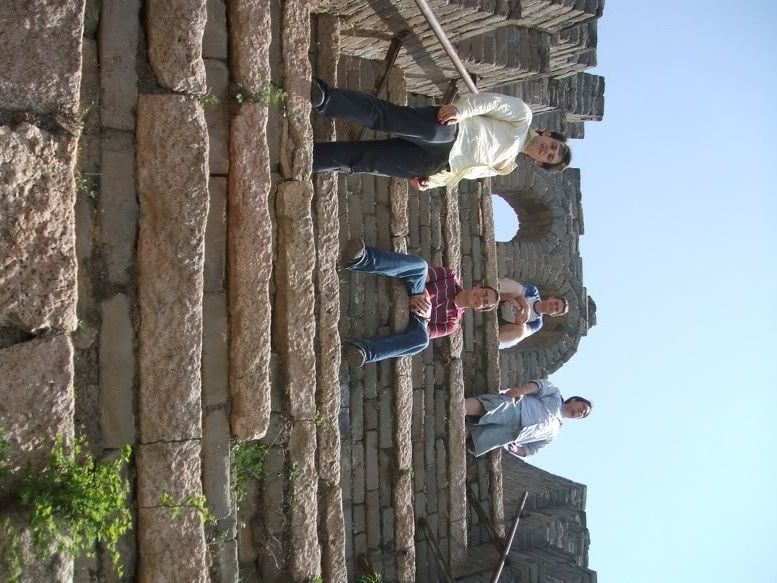
The Great Wall

I don't know what all I want to put up about my recent trip to China on here. Maybe some reflections, maybe a transcription of some of my travel journal, I don't know. But for now, I'll just give you one of my favorite pictures from one of my favorite stops on the trip: The Great Wall (I'm the one furthest to the right).

Photobucket - Video and Image Hosting

Fargus...

The Westboro Baptist Church

You all know these wackos. They're the ones who've gotten an undue amount of press because of their picketing of soldiers' funerals. The membership of the Westboro Baptist Church is under 100 people, and most of those are members of the family of Fred Phelps, the church's founder.

This group of lunatics has absolutely no association with any mainstream church, and the main thrust of their beliefs, or at least what they're choosing to highlight at present, is that God is passing righteous judgment on the United States for being too accepting of homosexuality. That's what the picketing is about. They claim that United States soldiers are being killed in Iraq because their country is too tolerant of homosexuality. These people are disgusting, delusional, and dangerous.

But think about this: but for the focus of their enmity, how do they substantively differ from such influential mainstream nutjobs as Jerry Falwell and Pat Robertson? Both of those men said, in the wake of September 11, that the terrorist attacks were a righteous judgment from God on a country that was too tolerant of, among other things, what they viewed as sexual lewdness. Same goes for Hurricane Katrina. My point is this: the Westboro Baptist Church's beliefs differ from those of Falwell and Robertson only in degree, not in kind.

Some might take issue with my citation of Falwell and Robertson as mainstream. I'd disagree, but for the sake of argument let's leave them aside. Let's look at the platform of the Republican Party, and in particular, the push for a Federal Marriage Amendment. These are people who believe that allowing homosexuals the same rights as heterosexuals will cause society to crumble. In other words, they believe that there will be direct negative consequences visited on America for too much tolerance of homosexuality.

You see where I'm going with this, right?

The Westboro Baptist Church isn't directly dangerous. They number too few, and they're crazy. They have no support for their insane views. The true danger of the Westboro Baptist Church, though, is that it creates a foil for those who fundamentally believe the same things as they do about homosexuals. Republicans get to support troops, get credit for opposing an anti-gay group, and then still turn around and vote to restrict gay rights. The Westboro Baptist Church is nothing but a distraction. They're a group that is so extreme that it allows people to imagine that they're being tolerant while they let themselves turn a blind eye to (and legitimize) their own prejudices.

Fargus...